
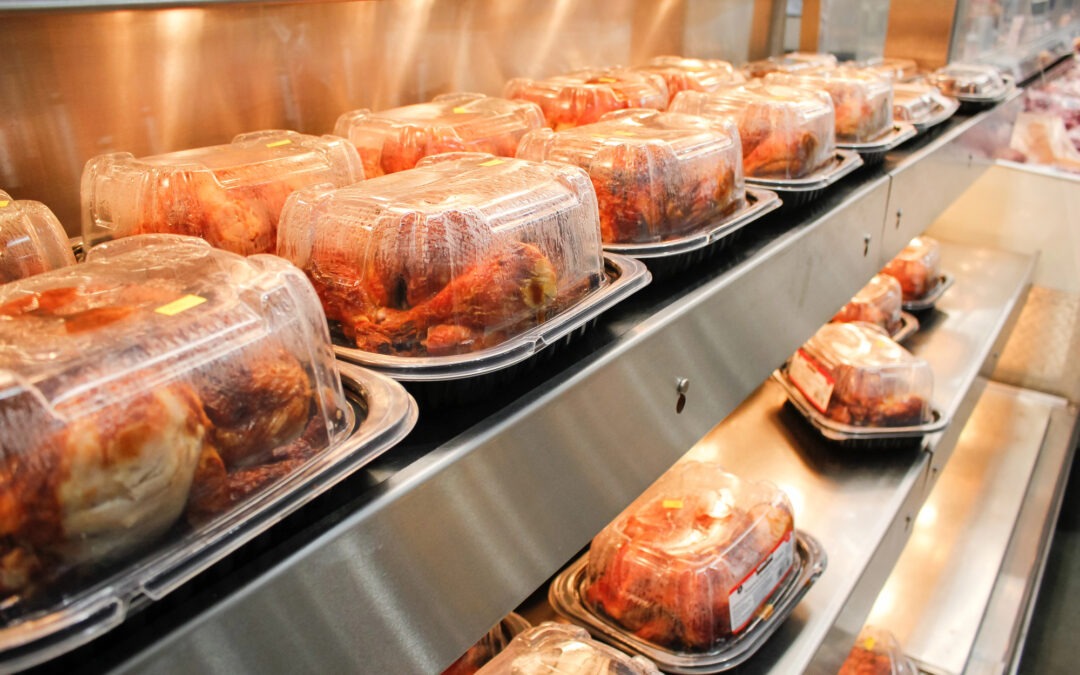
Have you ever walked into a grocery store, picked up a cooked rotisserie chicken for around $5, and wondered how in the world they can sell it for that price?
I have.
As an inventor and manufacturer, I spend a lot of time thinking about how products are made, what they cost, and how they get from one place to another. Every day I deal with another obstacle in the supply chain that I hadn’t considered.
It’s something most consumers never think about, especially when they complain about the cost of something.
Recently, I started wondering just how many people, companies, industries, and expenses are involved in getting one simple cooked chicken onto a grocery store shelf.
So I started making a list.
I came up with 250 different activities and cost categories involved in the supply chain.
And I’m sure I’ve barely scratched the surface.
The more I thought about it, the more fascinating it became.
That inexpensive chicken represents an extraordinary amount of innovation, manufacturing, engineering, transportation, technology, and human effort.
Yet most people just grab one for dinner without giving it a second thought.
The Supply Chain Starts Long Before the Chicken Is Born
Let’s start at the beginning.
Before you can raise a chicken, somebody has to produce one.
That means breeding farms, hatcheries, incubators, and people who specialize in poultry genetics.
There are buildings to construct, equipment to purchase, employees to pay, and electricity to keep the incubators running.
Then there are veterinarians, vaccinations, sanitation procedures, and transportation costs.
All of this happens before the chicken ever gets to the farm where it will be raised.
And we haven’t even gotten to the food it eats!
Who Grew the Corn to Feed the Chicken?
This is where the supply chain really starts getting interesting.
Chickens need food. That feed often contains corn, soybean meal, vitamins, and minerals.
But somebody has to grow the corn and soybeans.
That requires farmland, seeds, fertilizer, irrigation, tractors, harvesting equipment, fuel, and farm workers.
Somebody has to manufacture the fertilizer.
Somebody has to make the tractor.
Somebody has to manufacture the tires for that tractor.
And somebody has to mine the raw materials that go into making the steel used to build it.
Think about that for a minute.
We’re talking about a chicken, and we’ve already involved the mining industry!
Once the crops are harvested, they have to be stored, transported, processed, and mixed into animal feed.
That means grain silos, feed mills, specialized equipment, truck drivers, mechanics, and quality testing.
Then the finished feed has to be delivered to the poultry farm.
Every one of those steps costs money.
And every one depends on other businesses.
Raising the Chicken Is a Business All by Itself
Now the chicken finally arrives at the farm.
The farmer needs land, buildings, heating, cooling, ventilation, water, electricity, and feeding equipment.
There are employees, veterinary services, insurance, maintenance, cleaning supplies, and property taxes.
The chickens need constant care.
Temperature has to be controlled. Water systems must work. Equipment needs repairs. Diseases have to be prevented.
Modern commercial meat chickens are generally raised for about six to eight weeks.
Think about the amount of planning required to coordinate millions of chickens moving through this system.
And here’s something else people forget.
What happens if the power goes out?
A poultry farm may need backup generators. That means another piece of equipment, another manufacturer, another fuel supplier, and another maintenance expense.
One problem creates a whole new chain of solutions. I deal with this every day as a manufacturer.
Getting the Chicken to the Processing Plant
Once the chicken is ready, someone has to transport it to a processing facility.
That requires specialized trucks, loading equipment, drivers, fuel, insurance, scheduling, and vehicle maintenance.
The trucks themselves have their own enormous supply chains.
Who manufactured the engine?
Where did the rubber for the tires come from?
Who produced the computer chips controlling the vehicle?
How many businesses were involved in making the fuel available?
You can keep asking these questions almost indefinitely.
That’s what makes supply chain management so complicated.
Every business depends on other businesses that depend on still more businesses.
The Processing Plant Is an Engineering Operation
Now the chicken arrives at the processing plant.
This isn’t somebody standing in a kitchen preparing dinner.
Modern poultry processing facilities use specialized machinery to handle large volumes of birds while maintaining food safety standards.
The chickens have to be slaughtered, cleaned, inspected, chilled, and packaged.
That involves equipment manufacturers, engineers, maintenance technicians, sanitation crews, food safety specialists, and quality control employees.
There are government inspections, operating procedures, testing programs, and extensive recordkeeping.
The facility needs electricity, water, refrigeration, wastewater treatment, and waste disposal.
And somebody has to design, build, install, and maintain all that machinery.
In other words, the processing plant has its own supply chain.
So does every piece of equipment inside it.
Now We Need Packaging
The chicken has been processed, but we still aren’t anywhere near the grocery store.
It needs packaging. I’ve been through many different versions of packaging as an inventor and manufacturer.
That means plastic manufacturers, packaging designers, labeling companies, printing equipment, adhesives, barcodes, cardboard boxes, and shipping pallets.
Someone has to manufacture the packaging machinery.
Someone else has to maintain it.
Then there are the employees who inspect and package the products.
The packaging must help protect the food during storage and transportation.
And all of these materials have to arrive at the processing plant at the right time.
What happens if there’s a shortage of packaging?
Production can slow down even when there are plenty of chickens available.
Sometimes the smallest component can create the biggest supply chain problem.
Anyone who manufactures a product knows exactly what I’m talking about. I was ordering off the shelf caps for my water bottle and I decided to spend the extra money to have my own mold made for the caps so I would never have to worry about not having caps. An expense I didn’t count on.
Refrigeration, Transportation, and Warehousing
Next comes transportation to the grocery store.
Because chicken is perishable, temperature control is essential.
That requires refrigerated trucks, refrigerated warehouses, temperature monitoring equipment, and inventory tracking systems.
Every stop adds expenses.
Truck drivers must be paid. Fuel has to be purchased. Insurance is required. Warehouses need electricity and employees.
Refrigeration equipment must be maintained.
Delivery schedules have to be coordinated.
And if something goes wrong, the product may be delayed, rejected, or discarded.
That’s a lot of responsibility for a chicken that might sell for around $5.
We Finally Made It to the Grocery Store!
But wait.
The chicken still isn’t cooked.
Now the grocery store needs employees to receive it, refrigeration to store it, and equipment to prepare it.
Someone has to buy the rotisserie ovens.
Those ovens have to be manufactured, shipped, installed, cleaned, and repaired.
Then there’s electricity or gas to operate them.
The store needs seasonings, which have their own agricultural and manufacturing supply chains.
Employees prepare the chickens, cook them, and monitor food safety.
The finished birds must be kept at safe temperatures.
Then someone puts each chicken into a container.
But who manufactured that container?
Where did the plastic come from?
Who created the label?
Who printed the barcode?
And who manufactures the equipment that scans it at checkout?
We’re still adding suppliers and expenses.
Don’t Forget the Costs Nobody Sees
So far, we’ve focused mostly on producing and moving the chicken.
But running a business involves far more than buying materials and paying employees.
There are business licenses, property taxes, payroll taxes, insurance, regulatory compliance, accounting, legal services, financing, and administrative expenses.
Companies need computer systems, cybersecurity, inventory software, and payment processing services.
Workers need training. Equipment needs repairs. Buildings need maintenance.
There are safety requirements, inspections, and recordkeeping obligations.
Not every business faces exactly the same costs, but these expenses exist throughout the supply chain.
And here’s the part that amazes me.
All of these companies have to make their operations work economically while contributing to a product that may sell for just a few dollars.
How is that even possible?
Innovation Is the Reason This System Works
Imagine trying to produce that same chicken without modern technology.
No automated feeding equipment.
No specialized processing machinery.
No refrigerated transportation.
No computerized inventory management.
No modern breeding programs.
No efficient distribution networks.
How much would that chicken cost?
And how many people would be required to produce it?
Over time, innovators have developed ways to make almost every part of this process faster, more efficient, safer, or less expensive.
Farmers produce more with advanced equipment.
Manufacturers use machinery to increase output.
Transportation companies coordinate deliveries using sophisticated logistics systems.
Retailers use inventory data to plan demand and reduce waste.
Not every innovation involves inventing something completely new.
Sometimes innovation means improving a process, eliminating unnecessary steps, using equipment more effectively, or discovering a better way to solve an old problem.
And those improvements can add up to enormous savings across an entire industry.
That’s one reason a grocery store can offer a fully cooked chicken at such an affordable price.
Of course, some retailers also use aggressive pricing on rotisserie chickens to encourage customers to shop for other items.
But even with that strategy, the production system behind the chicken is an impressive accomplishment.
Why I See Innovation Differently as an Inventor and Manufacturer
I think about these things because I deal with supply chain challenges in my own business every day.
I invented swiggies, wearable wrist water bottles, and turned the idea into a manufactured product that has sold approximately one million units in 25 countries.
It started with a $5 clay prototype.
But coming up with the idea was only the beginning.
I had to figure out how to manufacture it.
That meant dealing with factories, materials, tooling, production costs, quality control, packaging, shipping, and inventory.
Then came the challenges of selling it and getting it into customers’ hands.
Every decision affects something else.
A change in materials can affect manufacturing costs. I found this out when I realized the factory might not be able to print on the bottles. That means I would have to print them and that requires more time and money.
A packaging decision can change shipping expenses. A simple header card and polybag is cheaper than an all plastic container, but might be needed for retail buyers.
A production delay can affect delivery schedules. I’ve been through this too and had to learn the prices of air freight which eats into my profit.
A quality problem can affect an entire shipment. There are numerous government regulations that many people don’t factor into costs.
And what happens when a supplier can’t deliver? I have had to set up manufacturing in different countries as a backup.
You have to figure out another way.
That’s where creative problem-solving becomes essential.
It’s also where I’ve learned some of my most valuable lessons about innovation.
Inventing a product is one thing. Figuring out how to manufacture it, sell it, and deliver it profitably is another.
I’ve experienced both sides.
Why Real-World Innovation Experience Matters
There are plenty of people who talk about innovation.
They study it, research it, write about it, and teach it.
There’s value in that.
But there’s also something you learn from actually trying to bring a product to market that you can’t get from studying somebody else’s success.
You learn what happens when your original plan doesn’t work.
You learn how quickly costs can change.
You learn how frustrating manufacturing problems can be.
And you learn that sometimes your best ideas come from solving problems you never expected to encounter.
That’s the perspective I bring to my work as an innovation keynote speaker.
I don’t just talk about the importance of creative thinking.
I show organizations how inventors approach problems, find opportunities, and develop competitive advantages.
Because I’ve had to do it myself as an inventor and manufacturer. One other thing I’ve had to deal with are legal issues with patents and trademarks. On top of fending off counterfeiters.
And the lessons apply far beyond manufacturing.
Every business has a supply chain of some kind.
Every business depends on suppliers, employees, processes, technology, and customers.
Every organization has opportunities to improve the way things work.
You just have to start looking for them.
The Next Time You Buy a Rotisserie Chicken
Take another look at that chicken sitting under the heat lamp.
Think about the farmers who grew the corn.
The engineers who designed the processing machinery.
The truck drivers who transported the feed.
The employees who monitored food safety.
The manufacturers who produced the packaging.
The people who built the refrigerators, trucks, ovens, and computers.
Think about all the businesses that had to coordinate their work to make that one purchase possible.
My list reached 250 activities and cost categories, and it could easily go much further if you traced every supplier backward.
What looks like a simple dinner is actually the result of generations of innovation and an extraordinary amount of cooperation.
That’s what I find so fascinating about inventing, manufacturing, and supply chains.
Innovation isn’t always a breakthrough invention that makes the evening news.
Sometimes it’s a small improvement that saves a few cents, reduces waste, speeds up production, or prevents a delay.
Multiply those improvements across an entire supply chain, and the results can be remarkable.
The next time you pick up a $5 rotisserie chicken, remember that you’re not just buying dinner. You’re buying the results of countless innovations that made it possible.
And here’s a question worth asking about your own business.
What ordinary product, process, or problem are you overlooking that could become your next competitive advantage?
Julie Austin is a patented inventor, manufacturer, and innovation keynote speaker. She is the creator of swiggies, wrist water bottles sold in 25 countries, and the author of Brainstreaming: Think Like an Inventor to Generate Breakthrough Ideas and Surviving Disruption: 12 Unique Innovation Strategies to Create Your Ultimate Competitive Advantage. Through her keynotes and workshops, she helps organizations apply real-world inventor thinking to solve problems, develop new ideas, and create competitive advantages.