

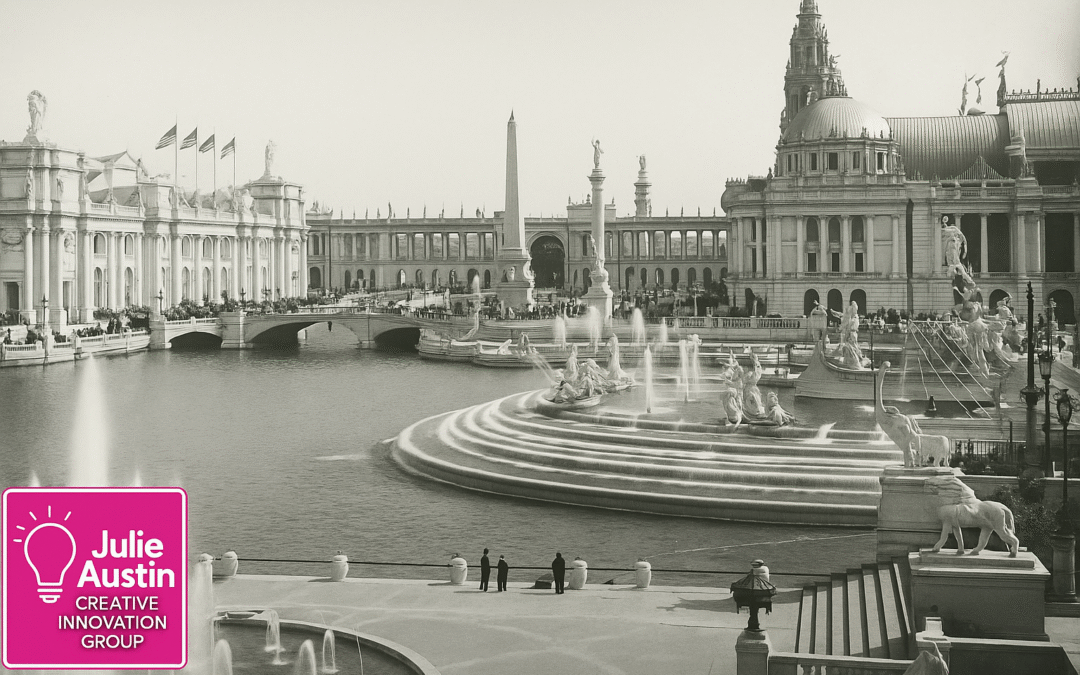
The Vision of the White City
Beaux‑Arts Grandeur and Urban Utopia
Daniel Burnham’s master plan for the White City married classical beauty with cutting‑edge construction, showing the world how civic ambition could be built at scale. Highlights include:
-
Unified Aesthetic: Over 600 acres of neoclassical façades, domes, and colonnades—all coated in a gleaming “staff” plaster that mimicked marble and created visual harmony.
-
Modular Design: Buildings were prefabricated in sections and assembled on‑site, proving that temporary expositions could rival permanent monuments in grandeur.
-
Balanced Layout: Every vista was choreographed—grand axes led from entry gates to major pavilions, while secondary paths branched to galleries and cafés, reinforcing a sense of order and discovery.
Visitors noted how the White City’s monumental scale instilled civic pride — reminding communities that inspiring public architecture can elevate everyday life.
Harmonizing Nature and Design
Frederick Law Olmsted’s landscape work wove serene green spaces through Burnham’s formal geometry, promoting both health and wonder:
-
Curving Lagoons: Meandering waterways reflected classical buildings, creating surprise reveals and cooling breezes on hot summer days.
-
Shaded Promenades: Tree‑lined walkways offered respite, encouraging leisurely exploration and social gathering.
-
Colorful Plantings: Beds of seasonal flowers and sculpted hedges edged formal plazas, proving that thoughtful horticulture can amplify architectural drama.
By blending built form with living landscapes, Olmsted demonstrated that innovation in urban planning lies in creating spaces that delight the senses and nurture community well‑being.
Electrifying the Fairgrounds
AC vs. DC: A Turning‑Point in Power
The White City became the stage for the famous “War of Currents,” and visitors saw first‑hand why alternating current would win:
-
Mass Illumination: Westinghouse’s AC system powered over 250,000 incandescent bulbs across the fair—far more than Edison’s DC networks could handle.
-
Long‑Distance Transmission: AC’s ability to carry high voltage with minimal loss convinced municipalities to adopt it for city‑wide lighting.
-
Wireless Demonstrations: Tesla’s experiments showcased contactless power—bulbs glowed wirelessly near coils, hinting at radio and future power transmission methods.
This clear victory reshaped electrical infrastructure, setting the standard for how we light streets, homes, and factories today.
Nighttime Spectacle and Lasting Legacy
When dusk fell, the White City transformed into a shimmering wonderland:
-
Buildings, fountains, and walkways glowed in soft ivory light, creating a theatrical experience that drew millions after dark.
-
Outdoor theaters used electric spotlights to stage evening concerts and shows, expanding cultural life beyond daylight hours.
-
The success of this grand illumination drove cities worldwide to install electric street lamps, extended factory shifts, and embrace 24/7 urban economies.
Ultimately, the White City’s electric brilliance proved that when technology and imagination unite, they can banish darkness and redefine how we live, work, and play.
Breakthrough Technologies on Display
The Ferris Wheel: Engineering on a Grand Scale
George Ferris’s giant wheel wasn’t just a fairground attraction—it was a declaration that American engineering could rival the world’s best. Key highlights include:
-
Monumental Height: Standing 264 feet tall, it towered over every pavilion and ride on the Midway.
-
Rapid Construction: Completed in under six months using modular steel trusses and prefabricated components.
-
Advanced Foundations: Timber pilings driven 32 feet deep into marshy soil, combined with steam‑thawing methods to secure concrete footings even in freezing conditions.
-
Massive Capacity: 36 enclosed cars, each holding up to 60 passengers, carried over 1.5 million riders during the Exposition.
By proving that large‑scale steel‑frame structures could be safe, reliable, and commercially successful, the Ferris Wheel inspired generations of architects and engineers to explore:
-
Observation wheels in global cities
-
Retractable roofs and stadium canopies
-
Early steel‑framed skyscraper designs
Search engines still return thousands of results for “Ferris Wheel Chicago World’s Fair” and “Industrial Revolution engineering marvels” because Ferris’s invention set the template for modern large‑span structures worldwide.
Advances in Communication and Transportation
The White City showcased breakthroughs that prefigured today’s fast‑moving, connected world. Highlights included:
-
Telegraph Multiplexing: Systems that sent multiple messages simultaneously over one wire, foreshadowing modern broadband and data‑streaming technologies.
-
Wireless Power Demos: Wireless‑lighting exhibits that levitated bulbs and demonstrated the potential for contactless energy transmission and early radio concepts.
-
Steam Locomotion: The Baldwin “Columbia” locomotive steamed in under its own power, proving that railroads could reliably move people and freight across vast distances without interruption.
-
Electric Carriage Prototype: William Morrison’s six‑passenger electric vehicle offered a glimpse of clean‑energy urban transport two decades before mass‑market automobiles.
-
Electric Transit Experiments: Prototype streetcars and trial electric‑rail lines hinted at future emission‑free public transit networks in major cities.
These innovations taught fairgoers—and future urban planners—that:
-
Information could traverse continents in seconds
-
Cities would soon glow with electric light around the clock
-
Mobility would shift from steam and horses to electric and automated systems
For anyone researching “telegraph history,” “steam engine evolution,” or “first electric car demonstrations,” the 1893 World’s Fair remains a pivotal moment when communication and transportation fused to redefine 20th‑century mobility.
The City Beautiful Movement
From Exposition to Urban Blueprint
When the gates of Chicago’s White City closed in 1893, its impact had only just begun. The fair’s meticulously planned grounds and Beaux‑Arts architecture inspired civic leaders to reshape cities on a grand scale. Key takeaways included:
-
Grand Boulevards and Axial Layouts: Wide, tree‑lined avenues replaced cramped streets, improving traffic flow and inviting leisurely promenades.
-
Civic Monuments as Anchors: Museums, libraries, and courthouses were positioned at vista termini, lending gravitas and wayfinding clarity.
-
Public Green Spaces: Formal parks, reflecting pools, and garden pavilions demonstrated the health and social benefits of accessible nature.
Chicago codified these ideas in its 1909 Plan, carving out lakefront parks, beautifying downtown boulevards, and setting a precedent for future city plans worldwide.
Global Reach
The White City’s blend of classical elegance and modern infrastructure caught planners’ imaginations far beyond the Midwest:
-
London and the Thames Embankment: Inspired by Chicago’s harmonious waterfront, authorities widened thoroughfares and built grand promenades along the river.
-
Paris and the Jardin des Tuileries Revival: French urbanists reintroduced axial gardens and symmetrical plantings that echoed Olmsted’s lagoon‑lined vistas.
-
Tokyo’s Ueno Park Enhancements: Japanese designers added neoclassical pavilions and formal figural sculptures, integrating western design principles into their imperial capital.
By proving that cohesive design could unify cultural, commercial, and civic functions, the World’s Fair became the template for 20th‑century urban renewal projects everywhere.
Education, Culture, and Social Change
Cultural Institutions and Exhibits
The White City wasn’t just about technology and architecture; it also foregrounded art, gender, and global heritage:
-
The Woman’s Building: Curated entirely by women, showcasing paintings, sculptures, and inventions—an early platform for female creativity.
-
Ethnographic Pavilions: Dozens of nations displayed traditional crafts, music, and dress, sparking cross‑cultural dialogue and curiosity.
-
Fine Arts Palace: Hosted rotating exhibits of classical and contemporary works, popularizing museum‑style galleries for public enjoyment.
While the fair’s inclusivity fell short by modern standards, it planted seeds for multicultural programming in today’s leading art institutions.
Technological Education
The White City pioneered interactive learning long before STEM became a buzzword:
-
Hands‑On Demonstrations: Visitors manipulated magnetic coils, experimented with chemical reactions, and observed early X‑ray prototypes.
-
Live Science Shows: Exploding boilers, jet‑powered pumps, and model electrical grids brought scientific principles to life.
-
Educational Lectures: Leading inventors and explorers delivered talks on subjects ranging from archaeology to aeronautics.
This fusion of entertainment and education influenced the design of science museums and discovery centers that emphasize tactile engagement and curiosity‑driven exploration.
Legacy and Lessons for Today’s Innovators
Bold Vision Backed by Meticulous Planning
The White City succeeded because its leaders combined audacious goals with rigorous execution:
-
Clear Master Plan: Every building, fountain, and pathway was plotted on a single cohesive map.
-
Engineering Precision: Foundations, lighting grids, and drainage systems were engineered to millimeter tolerances.
-
Coordinated Aesthetics: Color palettes, façade treatments, and landscape features were harmonized to evoke unity.
Modern innovation teams can learn that big ideas require detailed roadmaps and relentless attention to execution.
Integration of Art, Science, and Industry
Rather than isolating “tech demos” from “culture zones,” the fair wove them together:
-
Light sculptures lit alongside classical statuary.
-
Automata and kinetic art displayed in horticultural gardens.
-
Mechanized theaters presented both operas and scientific lectures.
Today’s experiential retail spaces, interactive public art installations, and maker‑faire events echo this seamless blend—proving that cross‑disciplinary collaboration fuels breakthroughs.
Innovation as a Catalyst for Civic Renewal
The White City showed that landmark events can jump‑start urban transformation:
-
Infrastructure Upgrades: Streets, utilities, and rail lines built for the fair remained in service for decades.
-
Tourism and Economic Growth: Millions of attendees boosted local businesses and encouraged future investments.
-
Global Recognition: Chicago cemented its reputation as a world‑class city, attracting expositions, conventions, and talent.
From Expo ’98 in Lisbon to Expo 2020 in Dubai, world’s fairs continue to spark infrastructure improvements and economic revitalization.
Tying White City Lessons to 2025 Innovation Keynotes
As an innovation keynote speaker in 2025, I often reflect on how the 1893 White City’s blend of grand design, cutting‑edge technology, and human‑centered spectacle still sparks breakthroughs today. Here’s how those century‑old lessons inform modern creativity talks and urban innovation strategies:
Visionary Master Planning in the Digital Age
-
From Axial Boulevards to Smart City Grids: Just as Burnham plotted vistas to inspire civic pride, today’s city leaders map data flows and IoT sensors to create intuitive, responsive public spaces.
-
Scalable Infrastructure: The modular “staff” buildings of 1893 predate today’s pop‑up pavilions and digital twin prototypes—emphasizing rapid deployment and testing before full‑scale rollout.
Electrification Meets AI and AR
-
AC Power to Augmented Reality: Westinghouse’s AC victory taught us that infrastructure choice drives adoption. In 2025, keynote talks spotlight how 5G and edge computing enable real‑time AR overlays on city streets—supercharging tourism and wayfinding.
-
Nighttime Activation: The White City’s illuminated nocturne now inspires dynamic LED façades and drone light shows, turning cityscapes into interactive theaters well into the 21st century.
Integrating Nature, Health, and Tech
-
Green Lanes to Biophilic Design: Olmsted’s lagoons echo today’s green corridors embedded with air‑quality sensors and outdoor Wi‑Fi. Keynote sessions often demonstrate how “living infrastructure” boosts both well‑being and connectivity.
-
Wellness as a KPI: Just as shaded promenades invited rest, modern offices and campuses integrate plant walls and light therapy pods—metrics we track alongside engagement and retention.
Spectacle Drives Engagement
-
Ferris Wheel to Virtual Ferris Rides: Ferris’s mechanical marvel proved spectacle attracts millions. In 2025, we leverage VR Ferris‑wheel simulations at conferences to immerse remote audiences in launch experiences.
-
Event‑Driven Urbanism: World’s Fairs once spurred infrastructure investment; today’s expos double as living labs for autonomous vehicles, public‑private innovation districts, and blockchain‑based identity systems.
Cross‑Disciplinary Collaboration
-
Art‑Tech Partnerships: The White City blended sculpture, theater, and machinery; now we bring street artists into hackathons and pair coders with environmental scientists—keynote audiences love seeing real‑world proof of concept.
-
Global to Local Feedback Loops: Just as the Exposition drew 27 million visitors, virtual conferences in 2025 unite global communities—immediately feeding insights back into local pilot projects.
Inbound Resources
-
Creativity & Innovation Keynote Speaker Blog: creativeinnovationgroup.com/creativity-innovation-keynote-speaker-blog
-
About Julie Austin: creativeinnovationgroup.com/about-julie-austin-keynote-speaker
-
Keynotes: Julie Austin: creativeinnovationgroup.com/keynotes-julie-austin
-
Buzz: Julie Austin: creativeinnovationgroup.com/buzz-julie-austin
-
The Whole Story: creativeinnovationgroup.com/the-whole-story
Authoritative References
-
Harvard Business Review: hbr.org/topic/innovation
-
World Economic Forum: weforum.org/focus/future-of-jobs
-
Forbes Innovation Channel: forbes.com/innovation
Frequently Asked Questions
1. How does White City planning inform smart‑city design today?
By demonstrating the power of unified aesthetics and logical axes, it teaches planners to integrate data networks and public art into coherent urban experiences.
2. What modern “modular” approaches echo the White City’s staff buildings?
Today’s rapid‑build pavilions, 3D‑printed structures, and prefabricated smart‑home prototypes all mirror that ethos of quick, cost‑effective deployment.
3. Why is nighttime activation still crucial for urban vitality?
Illuminated cities extend commercial hours, enhance safety, and offer 24/7 engagement opportunities—much like the White City’s electric spectacle did in 1893.
4. How do biophilic design principles trace back to Olmsted’s lagoons?
Integrating green spaces with technology—air sensors in parks or solar‑powered benches—follows his example of harmonizing nature and human activity.
5. What role does spectacle play in today’s product launches?
Immersive installations, drone light shows, and VR experiences serve the same function as the Ferris Wheel: capturing attention and making complex technology feel tangible.
6. How can event‑driven urbanism accelerate local innovation?
Hosting innovation expos or district showcases attracts investment, tests new mobility modes, and forges public‑private partnerships—just as the 1893 Fair did for Chicago.
7. What cross‑disciplinary collaborations are most effective now?
Pairing creatives, engineers, and policymakers in “innovation sprints” cultivates holistic solutions, echoing the Exposition’s mix of art, science, and industry.
8. How do we measure success for modern “White City” projects?
Key metrics include foot traffic, social media engagement, energy savings, public satisfaction surveys, and pilot adoption rates of new services.
9. What technologies are 2025 keynotes most excited about?
AI‑driven urban analytics, AR‑powered wayfinding, autonomous last‑mile delivery robots, and blockchain for transparent civic data all top the list.
10. How can organizations apply White City lessons internally?
Use themed showcase events, modular pilot rooms, and interactive installations to bring teams together, share prototypes, and spark cross‑departmental innovation.