

I just spent two weeks in Japan on a cruise, moving slowly through a country that doesn’t move the way the rest of the world does. And I kept noticing something I wasn’t expecting to notice: Japan isn’t a country in a hurry to be new. It’s a country in a long, patient conversation with what it already knows.
That’s not a critique. It might be the whole lesson.
The Word That Changes Everything
Before you can understand Japanese innovation, you have to understand one word: kaizen. It translates roughly as “continuous improvement,” but that translation flattens it. What kaizen actually means, lived out on a factory floor or in a Michelin-starred kitchen or in the design of a bullet train is this: every day, in every process, there is something worth making slightly better. Not reinventing. Not disrupting. Slightly better.
Toyota manufacturing
Toyota built one of the most imitated manufacturing systems in history on this idea. Workers on the line aren’t just operators. They’re the first people responsible for noticing what isn’t working. They can stop the entire line. They’re expected to. The person closest to the problem is the person best equipped to solve it, and the system was built to hear them.
We borrowed the word. I’m not sure we borrowed the belief underneath it.
Most of the organizations I’ve walked through are built on the opposite assumption. That the people at the top have the best view of what needs to change. Kaizen inverts that entirely. The improvement lives at the edge. And you only get it if you’ve built enough trust that people will tell you what they actually see.
What 300 Years of Practice Looks Like
In Kyoto, I watched a craftsman work on a piece of lacquerware. He was applying one of dozens of coats. Each one drying for days before the next could go on. The object he was finishing would take months to complete. He was maybe in his sixties. He had probably been doing this since his teens.
What he was doing wasn’t nostalgia. Lacquerware like his is showing up in contemporary design collaborations, high-end hospitality, and forward-thinking product lines. The technique is old. The applications are not.
Shokunin
Japan is full of this. The shokunin, the craftsperson, is a cultural archetype in a way that has no real American equivalent. The shokunin doesn’t just do a job. They commit a life to mastering one discipline, and the culture treats that commitment as a form of moral seriousness, not stubbornness. A ramen chef who has been perfecting the same bowl for forty years isn’t behind. They’re ahead of everyone who moved on too quickly to find out what the bowl was still trying to tell them.
Slow Thinking in a Fast World
Nintendo is headquartered in Kyoto, not Tokyo. That always seemed like a small fact until I spent time in both cities. Tokyo is electric, relentless, stacked. Kyoto breathes differently. It has the pace of a city that has been deciding what to keep for a very long time.
Nintendo doesn’t chase the technology frontier. They chase the experience. When the rest of the gaming industry was racing toward graphical realism and raw processing power, Nintendo made a small white box you could swing like a tennis racket. Then they made a console you could pull out of a dock and carry onto a train. The question they keep asking isn’t “what’s possible?” It’s “what would make this more fun?”
That is a different kind of restraint than limitation. It’s the restraint of a company that decided what it was for, and kept asking the same question long after it would have been easier to follow the crowd.
Restraint, I’ve come to think, is one of the most underrated conditions for creative work. The calendar with no white space produces nothing new. The process with no pause produces errors instead of improvements. The organization that can’t hold still long enough to notice what’s actually happening can’t improve what it can’t see.
The Architecture of Consideration
Japan’s cities are full of small decisions made with unusual care. The way a convenience store organizes its shelves. Tested and revised continuously, down to the angle of the label. The way the Shinkansen doors open precisely where the painted markers on the platform told you they would. The gloves and the bow from the taxi driver. None of it is accidental. All of it is the result of someone, somewhere, caring enough to make it slightly better than it had to be.
I’ve written before about Pixar’s atrium, the building Steve Jobs designed to force accidental collisions between people who wouldn’t otherwise cross paths. Japan feels like the inverse architectural lesson. It’s a culture that designed for attention. For noticing. For the belief that the details are where the real work lives.
You can’t install that in an offsite. You build it one response at a time, one iteration at a time, over long enough that it becomes the culture instead of the initiative.
The Longer Game
What I brought home from Japan wasn’t a framework or a methodology. It was more like a reorientation. A reminder that the most durable innovation isn’t always the loudest. That mastery and reinvention aren’t opposites. That paying close attention to one thing for a very long time is its own kind of radical act.
Innovation Isn’t Breaking Things. It’s Understanding Them.
The dominant story in tech for the last two decades has been disruption. Move fast, break things, apologize later if you have to. It produced some genuinely remarkable things, and it also produced a lot of wreckage that the people who moved fast didn’t stick around to clean up. Japan’s model is quieter and, I’d argue, more honest about what real progress actually requires. The most celebrated modern innovations, the ones that hold up, the ones people actually integrate into their lives, almost always turn out to have kaizen underneath them. The iPhone wasn’t a single stroke of genius. It was thousands of iterations. Spotify’s recommendation engine wasn’t born brilliant. It got better because someone kept asking what the listener actually wanted. The flash of inspiration gets the headline. The ten thousand small improvements are what make it last.
The classics that still resonate:
- The Toyota Prius, the world’s first mass-produced hybrid electric vehicle, debuting in 1997 Japanesewithhikari, is probably the cleanest example of kaizen applied to a global problem. Not invented overnight; refined over decades.
- Blue LED lighting developed in the early 1990s by three Japanese scientists paved the way for energy-efficient screens and power-saving lightbulbs World Economic Forum, eventually earning a Nobel Prize in 2014.
- The QR code was a Japanese invention Japanesewithhikari, created in 1994 by a Toyota subsidiary to track car parts, and now used by billions of people daily.
More recent and surprising:
- Japan’s combination of AI and robotics has become their answer to a rapidly aging labor force. Studies show 49% of Japanese jobs are automatable, and the country has one of the highest robot densities in the world at 3.09 robots per 100 people Weareeverise.
- Japanese startups are now tackling global healthcare access, one award-winning device uses smartphone technology to provide eye exams in countries with almost no ophthalmologists, and is now deployed across more than 25 developing countries Bloomberg.
- Japan was the first country to use hydrogen technology in actual on-road vehicles Japan Today, and continues to lead in hydrogen fuel cell development.
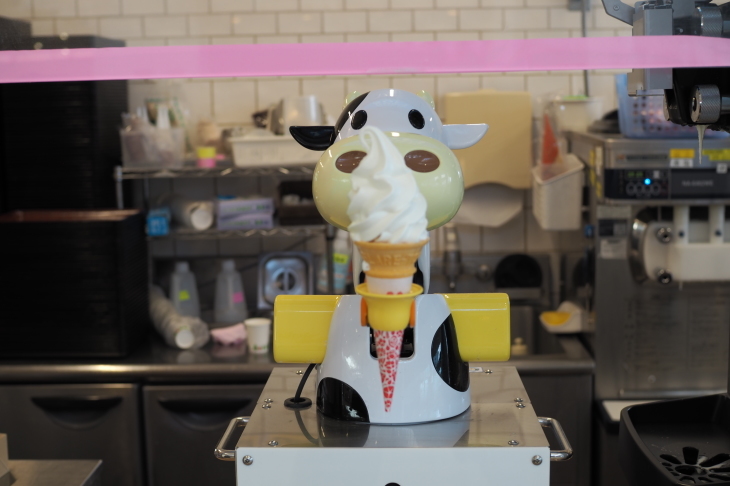
- My favorite is the robot cow that dispenses ice cream!