

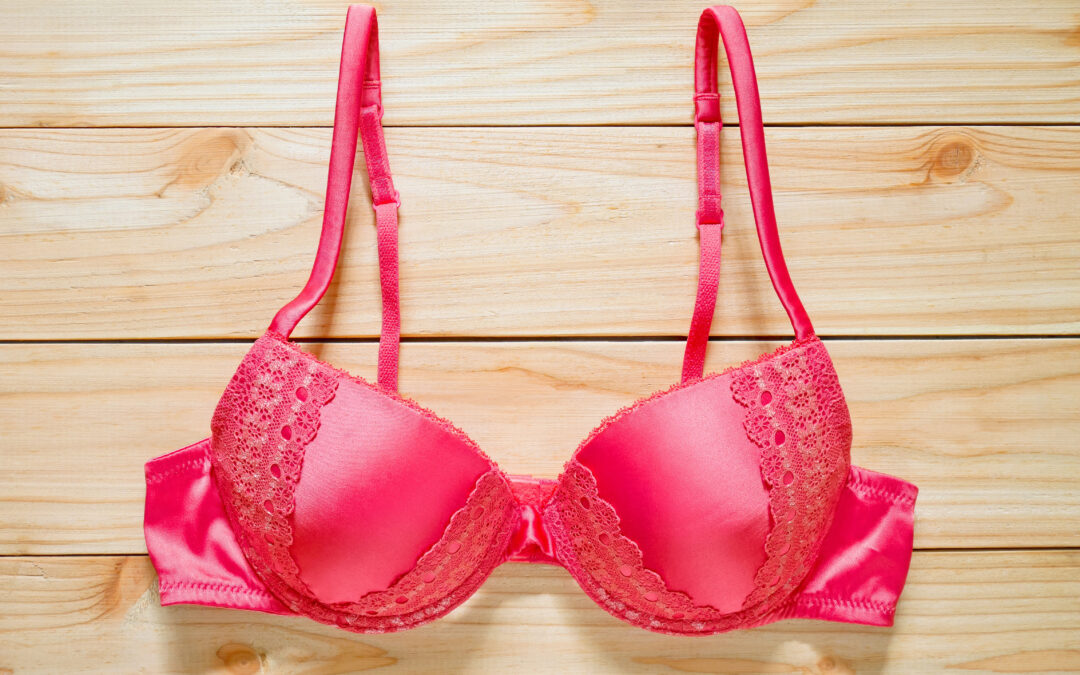
Since necessity is the mother of invention it’s no surprise that the bra inventor was a woman. A debutante and art patron named Caresse Crosby.
Caresse Crosby grew up the very definition of an upper-class debutante, moving between New York and Connecticut in a world where tradition wasn’t just expected—it was stitched into every social rule. Balls, dinners, and formal events were part of the routine. So were the rules of fashion, including the uncomfortable “must-have” foundation garment of the era: the whalebone corset.
One night, as she dressed for yet another ball, she did what women had been doing for generations. She pulled on her customary corset under her evening gown. And then she paused.
The gown wasn’t sitting right.
Instead of enhancing her silhouette, the corset made the dress look stiff and clunky. The lines were wrong. The shape didn’t flatter the gown’s cut. And while corsets were designed to force women into a certain form, they weren’t designed to work with delicate, modern eveningwear.
That’s the moment this story stops being about fashion and starts being about invention.
Bra inventor
Caresse didn’t shrug and accept it. She didn’t decide she was being “too picky” or assume the problem was her body or the dress. She assumed something else could exist.
Caresse called her maid in and asked for help fashioning a different garment to wear underneath.
And in a burst of practicality and creativity, she stitched together two handkerchiefs—simple, soft, and flexible—into something that accented her bustline rather than crushing it. It was light. It moved with her. Most importantly, it worked with the gown instead of fighting it.
If you’ve ever solved a problem by improvising with what you had on hand, you’ll recognize the genius of that moment. No factory. No fancy materials. And no grand plan. Just a clear problem, an immediate need, and a willingness to try something new. The bra inventor had stumbled onto a fashion item that would become a part of our everyday wear.
Invention of a new garment
That night at the ball, the reaction was instant.
Women noticed.
Not in a casual, polite way—but in an “everyone wants to know what you did” way. She was mobbed by women intrigued by the new garment. They wanted to see it. They wanted to understand it. And, most importantly, they wanted one of their own.
Then came the moment that turns an idea into a business possibility: a stranger offered her a dollar for one.
It wasn’t the amount of money that mattered. It was the signal. A dollar meant, “This isn’t just clever. This is valuable.” The market was speaking—right there on the dance floor. And it made something click for Caresse.
She might have a product on her hands.
So she did what inventors and entrepreneurs do when they realize they’ve stumbled onto something bigger than a one-night solution: she set out to patent it.
Patenting the bra
Her patent claims emphasized what made it different. It wasn’t just “another undergarment” and didn’t interfere with evening gowns. It worked with modern clothing. And it could fit a variety of different customers. It was adaptable, and it moved away from the rigid, one-style-fits-all mindset of corsetry.
She also stressed versatility—how it could be used for different settings, from evening wear to tennis wear. That point may sound small, but it’s actually huge. She wasn’t positioning it as a niche novelty. She was positioning it as a flexible solution to a broader, everyday problem.
The Patent and Trademark Office granted her a patent, and she gave it a name that made its purpose crystal clear: the Backless Brassiere.
And here’s where the story gets even more interesting.
Bra inventor becomes a woman manufacturer
Caresse didn’t stop at the patent. She decided to manufacture the product herself. She formed the Fashion Form Brassiere Company and hired women to sew the garments.
This is how I started out with my wrist water bottle. I had a licensing deal ready to go and only weeks before it was to be launched the company went out of business. So I decided to manufacture it myself. I had no knowledge of manufacturing or distribution but I knew I had to figure it out. This was before Shark Tank and I had no mentors to help me. I simply used common sense and realized I had to get a mold made first.
Bra inventor turns her product into a business
Caresse built an operation. She created jobs. She turned a simple improvised solution into a real business. A lot of people romanticize the “invention moment,” but the real work usually comes after: production, quality, labor, scaling, distribution. I can attest to that! Caresse stepped into that world.
But then life, and relationships, steered the business in a different direction.
At the request of her new husband, Harry Crosby, who had a very generous trust fund, she closed the shop. And she sold the patent to the Warner Brothers Corset Company for $1,500.
An inventor asks “What if?”
That decision has become the “what if?” part of the story.
Because Warner Brothers didn’t just dabble with the invention. They ran with it. Over the years, they reportedly made more than $15 million from the product. The original “Crosby” bra that Caresse had manufactured was produced and sold by Warner Brothers for a while, but the style never caught on in that form and was eventually discontinued.
Even so, the core concept had already been unleashed: a lighter, less restrictive alternative to the corset—something that better matched the direction women’s fashion (and women’s lives) were moving.
There’s a lesson in that, too. Sometimes the first version of a product isn’t what becomes the lasting standard. Sometimes the breakthrough is the shift in thinking. Caresse’s invention cracked open a door, and the world walked through it in its own evolving way.
The first version of my wrist water bottle product was not that great. I had the logo stamped into the bottle and the band was thick and clunky. It took several tries to get it to where it is today.
Caresse shifts gears into art patronage
Caresse and Harry Crosby went on to do something entirely different.
They didn’t settle into quiet domesticity. They lived an adventurous, exciting, and headline-worthy life—traveling the world in a whirlwind of art and decadence. Caresse and Harry became publishers and art patrons, immersing themselves in the creative circles of their time. They rubbed elbows with cultural icons like Dorothy Parker and Salvador Dali.
It’s a fascinating twist. The woman who helped change women’s undergarments also helped fuel the arts. Reinvention wasn’t a one-time event for her. It was a pattern.
Caresse Crosby’s story is a reminder that innovation doesn’t always start in a lab or a boardroom. Sometimes it starts in a bedroom, getting ready for a party, frustrated with how something looks and feels. The “aha” moment can happen in the middle of ordinary life. When you decide not to tolerate a problem as “just the way it is.”
She saw a problem and improvised a solution. She validated it in real time with real demand. Protected it with a patent and built a company to manufacture it. And even though she exited early, her idea still echoed through an entire industry.
That’s what invention looks like in the real world: a blend of necessity, creativity, timing, and the courage to believe your little workaround might actually be a breakthrough.