

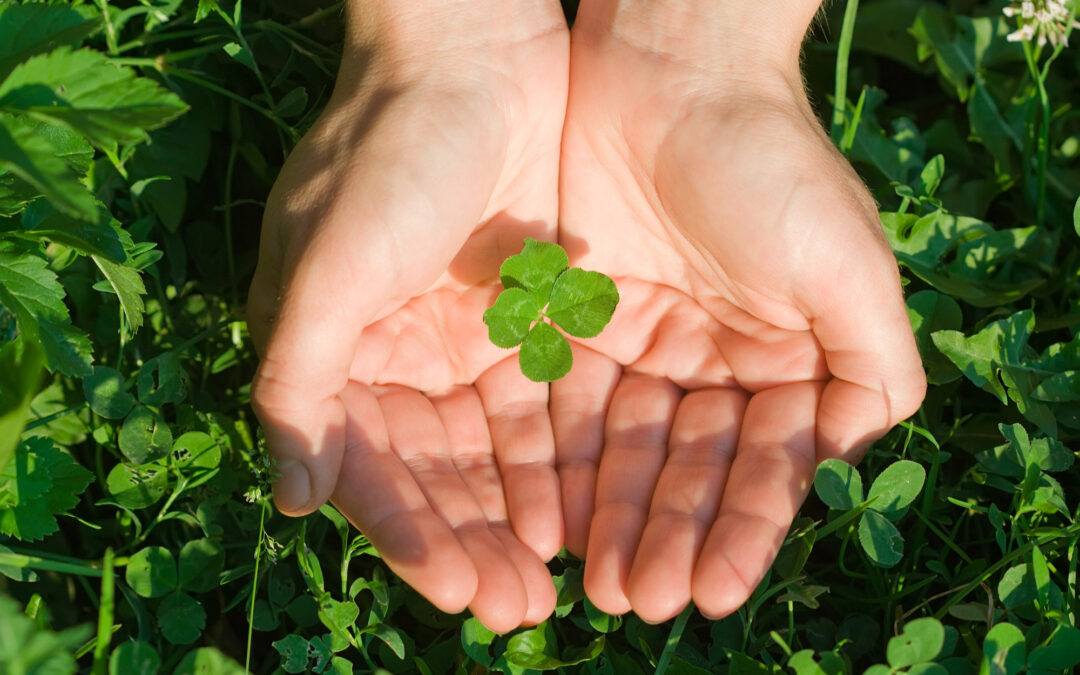
My book “Creating Serendipity: Think Like an Inventor to Generate Good Luck” is all about creating luck instead of waiting around for it to happen. Finding a four leaf clover is what we call dumb luck or blind luck. But how did it become associated with a little green leprechaun?
St. Patrick’s Day innovation
Every March 17, the world goes green. Rivers glow emerald in Chicago, massive parades march through New York and Dublin, leprechauns dance in bars, and pints of beer take on an unnatural hue. Shamrocks pop up everywhere from Sydney to Tokyo. But behind the festive chaos lies one of history’s most remarkable cultural innovations: St. Patrick’s Day itself.
What began as a quiet religious feast day honoring a kidnapped slave-turned-missionary has evolved into a worldwide phenomenon that blends faith, folklore, commerce, and pure joy. It’s not just a holiday. It’s a masterclass in adaptation, resilience, and creative reinvention. Here’s how it started, how Irish immigrants in America transformed it, and why it stands as one of the most innovative concepts in cultural history.
The Humble Origins: Saint Patrick and the Birth of a Feast Day
The story begins in the 5th century with a man who wasn’t even Irish. Born around 385 AD in Roman Britain as Maewyn Succat (later Patricius), young Patrick lived a comfortable life until Irish raiders kidnapped him at age 16. Sold into slavery in Ireland, he spent six years herding sheep on remote hillsides. Isolated and terrified, he turned to prayer and deepened his Christian faith.
Patrick eventually escaped, returned to Britain, trained as a priest, and, following a visionary dream, went back to Ireland as a missionary. His mission was revolutionary. Instead of imposing foreign doctrines, he adapted Christianity to local culture. Legend credits him with using the native three-leafed shamrock to explain the Holy Trinity. One plant, three leaves, mirroring Father, Son, and Holy Spirit. He’s also said to have banished snakes (a metaphor for paganism—Ireland never had them). By his death on March 17, around 461 AD, Patrick had baptized thousands and laid the foundation for Christianity in Ireland.
The holiday honoring him began as a straightforward Christian feast day in the 9th or 10th centuries. In Ireland, March 17 was a holy day of obligation. Families attended morning Mass, then enjoyed a modest afternoon feast. Lenten rules against meat were temporarily lifted, so people dined on Irish bacon and cabbage, danced a little, and celebrated quietly. Pubs remained closed by law until the 1960s. I didn’t know this, but blue, not green, was the original color linked to St. Patrick. There were no parades, no green beer, and certainly no river dyeing. It was spiritual, not spectacular.
American Innovation: Immigrants Turn Hardship into Heritage
The true spark of innovation ignited across the ocean. In the 18th and 19th centuries, waves of Irish immigrants arrived in America seeking opportunity, and faced fierce prejudice. Some of those were my anscesters, the Parnell family on my dad’s side and the O’ Farrells on my mom’s. Anti-Irish and anti-Catholic sentiment ran deep. Yet instead of hiding their identity, these immigrants did something brilliantly creative: they made their heritage visible and proud through public celebration.
The first recorded St. Patrick’s Day parade in North America actually happened in St. Augustine, Florida, in 1601, organized by an Irish priest in the Spanish colony. But the tradition exploded in the American colonies. Boston hosted an early gathering in 1737 when Irish Presbyterians formed the Charitable Irish Society. Then, in 1762, Irish soldiers serving in the British Army marched through lower Manhattan in New York City with bagpipes and drums. Homesick and defiant, they turned March 17 into a public display of pride—the first major parade in what would become the world’s largest St. Patrick’s Day event.
By the mid-19th century, after the Great Potato Famine drove nearly a million Irish Catholics to U.S. shores, these parades became powerful tools of resistance and community building. (I had heard that our family arrived here because of rotten potatoes.) Immigrants formed aid societies like the Friendly Sons of St. Patrick and the Ancient Order of Hibernians. In 1851, New York’s groups united for one grand parade. The same civilian procession that still marches today, stretching 1.75 miles with over 150,000 participants and millions of spectators.
These weren’t imported Irish traditions. They were bold American inventions born from necessity. Immigrants facing cartoons that mocked them as drunk and violent used parades to show political strength. Candidates courted the growing “green machine” voting bloc. President Harry Truman marched in New York’s parade in 1948, marking mainstream acceptance.
America also invented the festive flair we now take for granted:
- Wearing green became standard in the 19th century, tied to Irish nationalism and the “Emerald Isle.” Americans added the playful “pinch if you’re not wearing green” rule.
- Corned beef and cabbage replaced traditional Irish bacon; poor immigrants in New York slums bought cheap, briny corned beef from ships and boiled it with cabbage to stretch meals.
- Leprechauns, once minor figures in Irish folklore (cranky fairy shoemakers guarding gold), became parade mascots through American pop culture.
- Green beer emerged as a simple bar trick using food dye.
The pièce de résistance of American ingenuity arrived in Chicago in 1962. Plumbers from Local 130, testing pollution-control methods, dumped 100 pounds of vegetable dye into the Chicago River. It turned a brilliant green for an entire week. Purely by accident, but instantly iconic. Today, they use just 40 pounds of eco-friendly dye for a few hours, proving the tradition can evolve sustainably.
Ireland itself had no parades until the 20th century. The first major Dublin parade appeared in 1931, and the country only declared March 17 a public holiday in 1903. Modern Ireland’s multi-day festivals, launched in 1995 to boost tourism, drew inspiration from the energetic American model shown on TV. As historian Mike McCormack noted, “Modern Ireland took a cue from America.”
Modern Twists: Tech, Sustainability, and Global Reach
St. Patrick’s Day continues innovating today. The COVID-19 pandemic forced virtual parades and online pub crawls, proving the holiday’s adaptability in the digital age. Now, AI generates custom Irish music playlists, AR filters turn your selfie green, and apps coordinate global virtual events for remote teams. Marketing teams use data analytics for targeted “green” campaigns, while sustainable practices—like biodegradable dyes and zero-waste parades—address environmental impact.
The holiday has gone fully global. Parades happen in Japan, Russia, Singapore, and beyond. Guinness reports massive sales spikes. People of every background join in, turning what was once an Irish Catholic observance into an inclusive festival of fun and heritage.
Why St. Patrick’s Day Is the Ultimate Innovative Concept
St. Patrick’s Day exemplifies innovation because it shows how culture can be reimagined in the face of adversity. Patrick himself innovated by weaving Christianity into Irish life using local symbols. 19th-century immigrants innovated by transforming discrimination into defiant celebration. Their American-born traditions looped back to enrich Ireland and spread worldwide.
This holiday adapts brilliantly: from solemn Lent feast to secular party, from religious rite to commercial spectacle, from local observance to global party. It fuses faith and folklore, hardship and humor, past and present. In a world obsessed with technological disruption, St. Patrick’s Day reminds us that the greatest innovations are often human—resilient communities creating joy from struggle, exporting culture with creativity, and evolving traditions without losing their soul.
So this St. Patrick’s Day, when you sip that green beer or watch the Chicago River shimmer, remember you’re participating in something far deeper than a party. You’re celebrating 1,500 years of ingenuity: one man’s missionary vision that Irish immigrants turned into a worldwide phenomenon.
Sláinte to the most innovative holiday ever invented. Wear green proudly—because the luck of the Irish is really the creativity of the Irish spirit.